
AEO vs SEO for Law Firms: Why Adapting is Crucial for Your Practice


For more than a decade, law firms have been told a reassuring story: invest in SEO, publish regular content, refresh your practice area pages, and clients will find you. It was a tidy, predictable formula that worked well for a long time. However, the debate around AEO vs SEO for Law Firms isn’t just theoretical; it’s now a defining factor in whether a firm appears in AI-generated answers at all. The way clients search for legal expertise has changed dramatically, and the legal industry is lagging behind.
The result is a widening gap between what firms think drives visibility and what actually does. SEO hasn’t failed law firms; law firms have failed to evolve with the way people now look for answers.
The Shift in Client Behaviour
Today, clients don’t “search” in the traditional sense. They ask. They ask ChatGPT, Gemini, Copilot, Perplexity, and other AI-powered search results that no longer present a list of ten blue links. Instead, they provide one answer—a single, synthesised, authoritative response. In essence:
“Search is no longer a list of links. It’s a single AI answer, and if you’re not in it, you don’t exist.”
This shift is not subtle; it is structural.
The Latest Research Backs This Up
Gartner’s 2026 forecast predicts a 25% drop in traditional search, and the early signs are already visible. Australian and New Zealand legal clients are moving away from “blue links” and towards AI-generated answers that resolve their questions instantly without ever visiting a law firm’s website.
The behaviour change is profound. People are no longer browsing; they are conversing. They are not comparing firms; they are accepting the answer the AI gives them. SEO gets you indexed. AEO gets you chosen.
If your firm isn’t optimised for answers, you’re invisible in the only place that matters.
The Collapse of Traditional Search: A Shift Law Firms Can’t Ignore
This shift is not theoretical. It is measurable and accelerating.
65% of all Google searches now end without a click, according to SimilarWeb’s 2024 Zero-Click Search Study.
AI Overviews are appearing in more than 40% of legal-related queries, based on early tracking from multiple SEO platforms.
ChatGPT receives over 1.6 billion visits per month, with legal questions consistently among the top categories.
The legal sector has one of the highest theoretical AI coverage levels of any profession, meaning AI is exceptionally capable of answering legal questions. However, most law firms still aren’t structured to appear in AI-generated answers, meaning potential clients are being directed elsewhere.
This is the heart of the problem. AI is ready to answer legal questions. Law firms are not ready to be the source of those answers.
The New Reality: AI-Driven Search
Traditional SEO was built for a world where users typed keywords, compared options, and clicked through to websites. That world is gone. AI-driven search collapses the journey. The comparison step disappears. The click disappears. The user asks a question, and AI gives them an answer. If your firm isn’t part of that answer, you’re not part of the shortlist.
AEO vs SEO for Law Firms: Visibility vs Authority
The distinction between AEO vs SEO for Law Firms is simple but profound.
SEO asks whether search engines can find your content. AEO asks whether AI trusts your content enough to use it.
These are not the same thing.
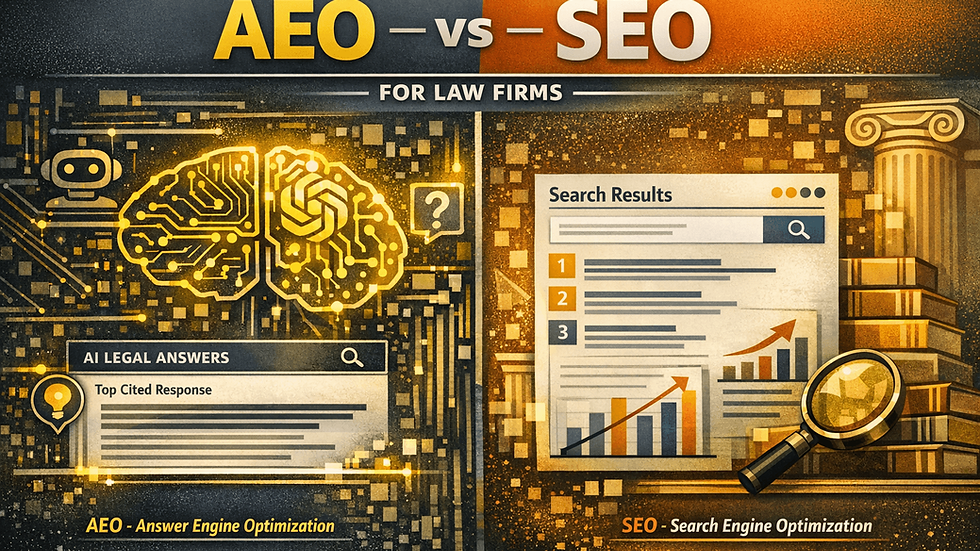
AI doesn’t care about keyword density or how many blogs you’ve published. It cares about whether your firm has demonstrated expertise, clarity, structure, and credibility across the entire digital ecosystem. It cares about whether your lawyers have visible authority profiles. It cares about whether your content is machine-readable, semantically rich, and consistent with your claimed areas of expertise. It cares about whether the rest of the internet agrees that you are who you say you are.
This is why SEO alone is no longer enough. SEO is about pages. AEO is about authority.
Why Law Firm SEO Fails in the AI Era
Most law firm SEO content is not fit for purpose in an AI-driven world. It is generic, repetitive, templated, and often written by vendors who don’t understand the law. The result is a sea of indistinguishable articles that could have been written by any firm, in any jurisdiction, at any time.
AI models are trained on vast amounts of legal content. They can instantly recognise when a piece of writing is thin, derivative, or lacking in genuine expertise. When your content sounds like everyone else’s, AI treats you like everyone else. And “everyone else” is not who gets chosen.
Recent analyses of law firm content performance show that the vast majority of blog posts still fail basic AEO criteria such as structured answers, semantic depth, and clear authorship, while very few firms are using schema markup or entity-based optimisation in a meaningful way.
A resource from Good2bSocial noted that fewer than 10% of Am Law 200 firms use schema markup, one of the most important signals for machine readability. This is not a technology problem. It’s a strategy problem.
AI Doesn’t Read Your Website — It Evaluates Your Firm as an Entity
This is the shift most firms have not yet understood. AI models don’t “crawl” your site the way Google once did. They evaluate your firm as an entity.
They look for patterns, signals, citations, authorship, and semantic depth. They cross-check your expertise across platforms. They assess whether your digital footprint is coherent, credible, and consistent. They look for external validation—media mentions, citations, awards, publications, and thought leadership that exists beyond your own website.
The legal sector has high theoretical AI coverage, but the observed coverage, the actual visibility that firms achieve, is far lower. The gap between the two is where opportunity is being lost.
If your online presence is thin, outdated, or fragmented, AI will not trust you. And if AI doesn’t trust you, it won’t use you.
AEO: The New Operating System for Law Firm Visibility
AEO—Answer Engine Optimisation—is not a buzzword. It is the new operating system for digital visibility.
AEO ensures your firm:
Appears in AI answers
Is cited as a trusted source
Has content that machines can understand and evaluate
Builds entity-level authority
Strengthens lawyer-level expertise signals
Maintains cross-platform consistency
Is discoverable even when users never click a link
In a world where clients ask AI for legal guidance, the only firms that matter are the ones AI trusts. The firms that understand the shift from AEO vs SEO for Law Firms will dominate AI-driven visibility. Those that don’t will quietly disappear from the consideration set without ever knowing why.
The Future of Law Firm Marketing
As we move forward, the importance of AEO will only grow. Law firms must adapt to this new reality. Embracing AEO is not just about staying relevant; it’s about thriving in a landscape that is rapidly changing.
The legal industry is slow to change, which is precisely why early adopters will dominate. The firms that embrace AEO now will capture AI visibility, build long-term authority, and become the default answer in their niche. The firms that don’t will spend the next five years quietly wondering why enquiries have dried up, why their competitors seem to be everywhere, and why their once-reliable digital presence no longer produces results.
SEO is not dead. It’s simply no longer enough. The firms that win in the AI era will be the ones that stop optimising for search engines and start optimising for answers. Because in this new landscape, visibility isn’t about being found. It’s about being chosen. At the core of the AEO vs SEO for Law Firms debate is that right now, most law firms haven’t given AI a single reason to choose them.


