What Makes a Law Firm Citable by AI?

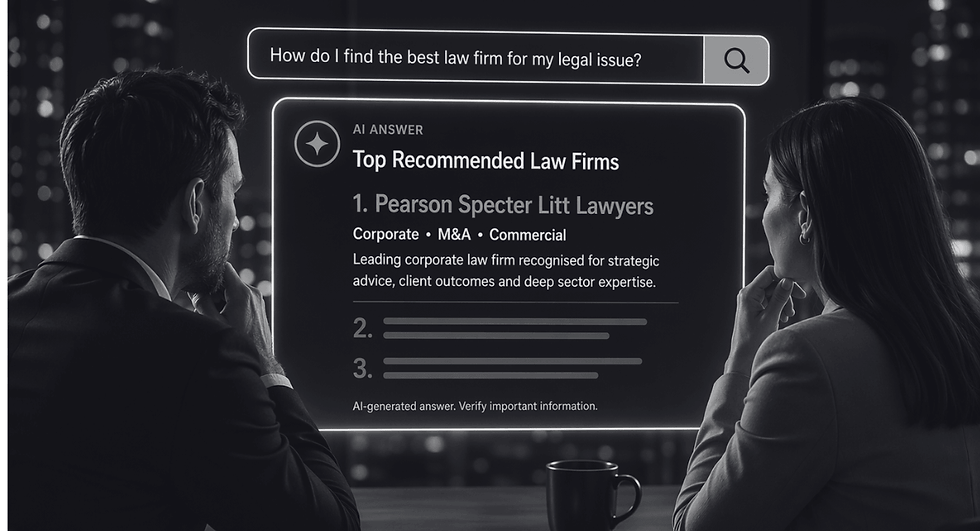
Being visible now means more than showing up on Google, it’s about showing up in the answers your clients are actually looking for. It’s important to understand the difference between being part of an AI-generated answer (Answer Engine Optimisation, or AEO) and traditional SEO, and why adapting matters. If your firm isn’t being picked up, referenced and trusted by those systems, you simply won’t appear when it counts. For firms across Australia and New Zealand, that makes being “citeable” less of a technical idea and more of a commercial imperative. What makes a law firm citable by AI? Your expertise, your people and your credibility need to be clear and consistent enough that AI can confidently surface you ahead of the competition.
What makes a law firm AI citable?
A law firm is citable by AI when its content and digital presence are clear, credible and structured enough to be selected in AI-generated answers. In simple terms, AI systems must be able to understand what the firm does, trust it as a source and confidently use it in response to a client’s question. This is no longer about being indexed. It is about being selected.
Most law firms do not have a visibility problem. They have a trust problem.
Many firms understand that traditional SEO is no longer enough. They can see that clients are asking full questions and interacting with AI instead of browsing results. But the assumption that a strong website and consistent publishing will lead to inclusion in AI answers is flawed. AI does not cite law firms because they exist. It cites them because it can rely on them as part of a credible answer. The difference is subtle but critical.
Authority has changed.
In the past, authority was signalled through rankings, backlinks and content volume. Those signals still matter, but they are no longer decisive. AI is not just measuring relevance. It is assessing trust. That trust is built through clarity, consistency and verifiability. If a firm’s expertise is vague, its external presence inconsistent and its messaging unclear, AI has little reason to include it. Firms that are precise, consistent and reinforced across credible sources become easier to cite.
AI does not read like a human.
A human reader can interpret nuance and infer expertise over time. AI cannot. It needs clarity and structure. It looks for direct answers, clear positioning and content that is easy to extract. Most law firm content was not designed this way. It was written to rank, not to be used. If AI cannot quickly identify what a firm does and why it matters, it moves on.
Your website is no longer the whole story.
AI does not rely solely on your website to determine credibility. It pulls signals from across the digital environment, including directories, media mentions, professional profiles and consistent business data. This changes the nature of authority. A firm is no longer defined only by its own content, but by what can be verified externally. Reputation becomes structured proof rather than brand positioning.
What being AI citable actually looks like.
What makes a law firm citable by AI? What does “being citeable” actually look like in practice? It’s not about chasing one platform, it’s about showing up consistently across the sources AI trusts. For law firms, that typically means established legal directories like Chambers and Legal 500, credible industry bodies such as law societies, well-structured firm websites, and high-quality third-party commentary or articles. Even sources like Wikipedia or reputable media coverage can play a role, but only if the information is accurate and independently verifiable. AI isn’t relying on a single source; it’s triangulating. The firms that get surfaced are the ones that appear consistently across multiple credible locations, with aligned messaging about their expertise and people. This is where most firms fall down, not through lack of profile, but through inconsistency.

Being citable is not the same as being well known.
Established firms do not automatically perform better in AI search. Visibility is not driven by history or perception. It is driven by clarity and consistency. Smaller firms with sharper positioning and stronger digital signals can outperform larger firms with broader but less precise market presence.
This is where most firms struggle.
The challenge is rarely expertise. It is how that expertise is presented. Content is often broad when it needs to be precise. Messaging is implied rather than stated. Digital signals are fragmented. AI is not judging capability. It is judging whether a firm can be clearly understood and trusted within seconds.
Firms that are easiest to cite share common characteristics. Their positioning is clear, their content answers real questions directly and their authority is reinforced consistently across multiple trusted sources. They do not rely on volume. They rely on clarity and credibility.
In the AI era, authority is no longer something a firm claims. It is something that must be visible, verifiable and usable. Firms are not cited because they are established or busy. They are cited because AI can understand them, trust them and deploy them as part of an answer.
That is what it means to be citable. The firms that realise this and adapt to it the quickest will reap the biggest long-term rewards.